

AI Agents That Do the Work, Not Just Answer the Question
Chatbots respond. Agents act. The difference sounds small until an agent has to pull data from three systems, update a record, route an approval, and know when to stop and ask a human. That is the point where most agent pilots quietly lose momentum.
Orionsoft Technologies is built to close that exact gap. Every agent is engineered around your live workflows, your actual tools, and the people who will supervise it every day — not tuned for a one-time demo. The result is production-grade agentic AI, built to keep performing when the process gets messy on an ordinary Monday morning.
What Gets Built Here
The full agent lifecycle is covered under a single engagement, removing the need to coordinate multiple vendors to deliver one working agent.
Agentic AI Strategy & Roadmapping
Before a single agent is built, time is invested in identifying which workflows genuinely benefit from autonomy and which are better left to rules or a human. This includes a tool-readiness assessment, a prioritised list of high-ROI agent use cases, a business case backed by real numbers, and a roadmap ready to present to leadership.
Custom AI Agent Engineering
Agents are architected and delivered end to end — spanning planner design, tool selection, memory, execution loops, deployment, monitoring, and scaling. Whether the starting point is a clean slate or a legacy workflow in need of modernisation, decisions are made with the scale of year three in mind, not just launch day.
Multi-Agent Orchestration
Where one agent is not enough, teams of specialised agents are built to collaborate — one researching, one drafting, one validating, one routing. Handoffs, shared memory, and conflict resolution are designed in as standard, not discovered after the first orchestration failure.
Tool Use & API Integration Agents
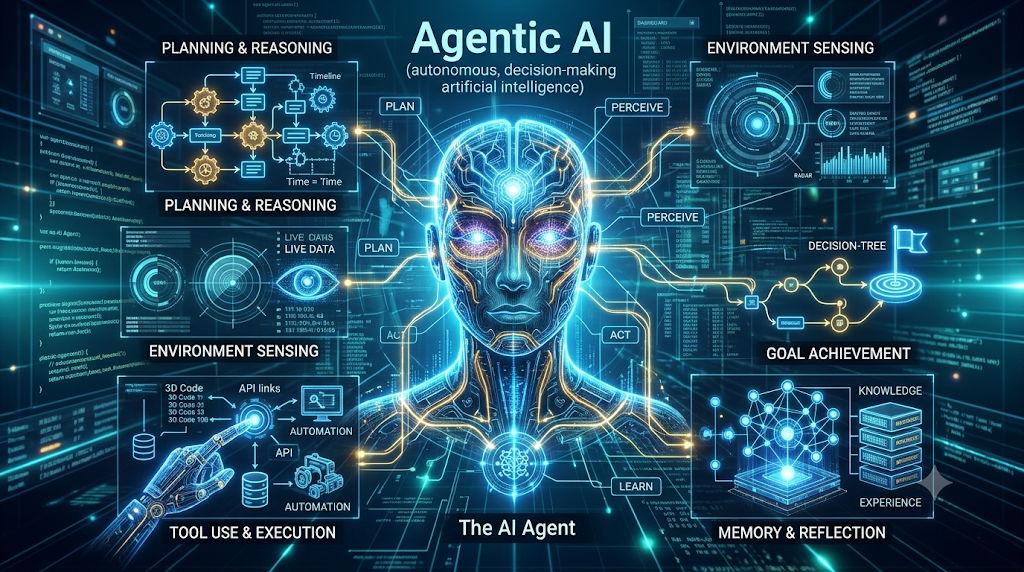
Agents built by Orionsoft go beyond answering questions — they execute multi-step tasks such as pulling data, updating records, sending emails, and routing approvals. Existing CRMs, ERPs, ticketing platforms, and internal APIs are met where they stand, without a rip-and-replace approach.
Autonomous Workflow Agents
Repetitive back-office processes are automated end to end — onboarding, invoice handling, ticket triage, procurement, reporting. Human review checkpoints remain in place throughout, ensuring oversight on anything sensitive or high-value.
RAG & Agentic Memory Systems
Agents are connected to internal documents, policies, and databases, ensuring decisions are grounded in your organisation's own knowledge rather than generic information from the internet. Long-term memory and context retention are handled deliberately to keep performance consistent across sessions.
Agentic AI Consulting
Independent guidance on which agent frameworks, foundation models, and orchestration patterns are a fit for your business — matched against your existing stack and explained in plain language. Build-versus-buy trade-offs are evaluated without vendor bias.
Agent Safety, Guardrails & Evaluation
Autonomy without boundaries is a liability. Permission scopes, tool-level allowlists, hallucination checks, escalation rules, and full audit trails are designed in from the start, so the agent knows exactly what it can and cannot do.
AgentOps & Ongoing Optimisation
Agents drift, tools change, and data evolves over time. Monitoring, replay, evaluation harnesses, and retraining pipelines are established to keep accuracy intact well beyond go-live — and to catch regressions before users do.
How the Work Happens
The process is kept deliberately tight and iterative, so working agent output is visible early rather than after months of silence before a single big reveal.
Agentic Discovery
Structured workshops with your team, a review of existing systems, and a clear assessment of where autonomy genuinely creates measurable value — not just novelty. This phase concludes with a prioritised roadmap, not a wishlist.
Tool & Data Preparation
An agent is only as capable as the tools and data it can reach. APIs, knowledge bases, and records are mapped, cleaned, and structured — and if something isn't ready, that is communicated honestly and early.
Agent Design & Architecture
The most suitable pattern is selected for the problem at hand: a single tool-using agent, a multi-agent team, or a deterministic workflow with an AI layer. Alternatives are tested rather than defaulting to whatever happens to be trending.
Development & Tuning
Agents are built and tuned on real-world tasks, with optimisation focused on the edge cases that tend to break lesser systems — ambiguous inputs, missing fields, tool failures, and unexpected state.
Testing & Evaluation
Rigorous testing covers task success rate, tool-call accuracy, safety boundaries, latency, and failure modes, with clear documentation of what the agent can and cannot do — and how it behaves when it doesn't know.
Deployment & Integration
Agents are deployed into your environment — cloud, hybrid, or on-premise — with proper API layers, permission scopes, and complete integration testing before they touch live systems.
Monitoring & Continuous Improvement
Drift, task success, tool usage, and cost are tracked after launch, with retraining, evaluation updates, and refinement built in as the business continues to evolve.
Industries Served
The agent pattern shifts by domain, because an agent for a hospital and an agent for a logistics fleet aren't the same problem.

Healthcare
Clinical documentation agents, patient triage assistants, referral routing, prior-authorisation workflows

Finance & FinTech
Fraud investigation agents, KYC review automation, document processing, compliance monitoring

Retail & eCommerce
Order-exception agents, returns processing, catalogue enrichment, support triage automation

Manufacturing
Maintenance-triage agents, quality-exception routing, supplier coordination, production reporting

Logistics
Shipment-exception agents, carrier coordination, delivery rescheduling, fleet intelligence

Real Estate
Lead-qualification agents, tenant screening, market research automation, document handling

Education
Enrolment agents, content-generation workflows, assessment support, student-support triage

Energy & Utilities
Outage-triage agents, field-service dispatch, regulatory reporting, predictive asset workflows
Why Teams Pick Orionsoft
We engineer agentic AI for live production reality, sustainable performance, and transparent business impact.
The business workflow comes first, not the agent
Where a rules engine or a simpler automation would solve the problem more effectively than an agent, that is the recommendation made — even if it results in a smaller invoice.
Production is the target from day one
Tool failure handling, escalation paths, observability, and cost control are part of the architecture from the outset, not features added after an unexpected bill arrives.
Guardrails are treated as a first-class requirement
Permission scopes, audit trails, and regulatory alignment — including GDPR, HIPAA, SOC 2, and the EU AI Act — are designed in based on where your business operates.
Humans stay in the loop
For anything high-stakes, review checkpoints, override controls, and escalation rules are built into the system. Agents are positioned to support your team's judgement, not quietly replace it.
Support doesn't end at launch
Monitoring, evaluation, retraining, and improvement continue well beyond go-live, because an unmaintained agent degrades over time — and prevention is far simpler than remediation.
The Technology Behind It
Enterprise-grade frameworks, foundation models, agentic workflows, and cloud-native AgentOps architectures.
Languages
Agent Frameworks
Foundation Models
RAG & Vector Stores
Reducing the Risk in Agentic AI
Most agent failures can be traced back to unclear boundaries and weak guardrails rather than model quality. Protection is built in at the architecture level from the start, not added as an afterthought.
Task accuracy safeguards
Agent actions are grounded in verified sources, with consistency checks in place so the agent responds with “I don't know” or escalates rather than taking an inaccurate action.
Tool permissions & least privilege
Every agent runs with a scoped set of permissions, tool-level allowlists, and rate limits — so it can only do what it was explicitly designed to do, nothing more.
Compliance by design
Regulatory standards relevant to your industry and region are incorporated from the first architecture diagram, not addressed as a pre-launch scramble. Full audit trails are kept for every agent action.
Answers Before You Ask
Let's Talk About What an Agent Could Do for You
A finished plan is not a prerequisite for starting the conversation. If there is a process that feels like it should be handled end to end — even without complete certainty about how — that is precisely the kind of conversation worth having.
Book a Free Consultation →