
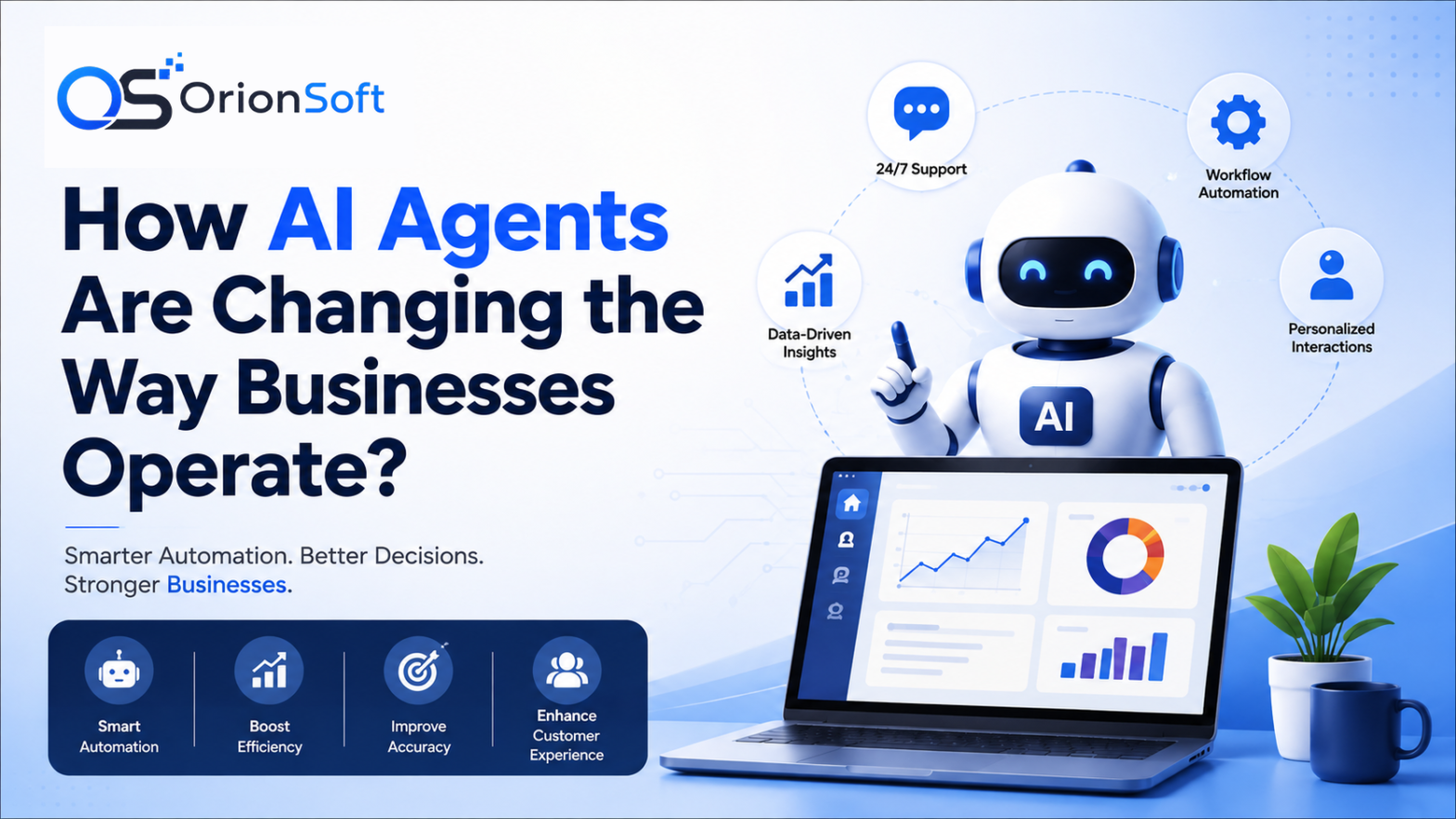
Most of us first met AI as a chatbot. You ask a question, it gives an answer. AI agents go one step further. You give them a goal, and they plan the steps, use your business tools to carry them out, and call in a person when something needs judgment.
That is why AI Agent Development is getting so much attention. McKinsey’s 2025 global AI survey found that 62% of respondents said their organizations were at least experimenting with AI agents, and 23% were already scaling one somewhere in the business. The real question is no longer whether AI can do the work. It is which workflow to hand over first.
What Are AI Agents for Business?
An AI agent is software that works toward a goal. It understands the request, uses authorized tools and data, takes action, and stays within the rules your business sets.
Picture a customer asking, “Where is my order?” A chatbot shares a tracking link. An AI agent finds the customer, checks the order in your CRM or e-commerce system, explains the delay, raises a ticket if needed, and passes unusual cases to your team.
The difference is action. The agent does not just talk, it finishes the job. It also works alongside your existing automation, not instead of it. Rule-based tools still suit fixed tasks, while agents handle work that needs language and context.
4 Ways AI Agents Are Changing Operations
1. Whole Workflows, Not Single Tasks
Older automation handles one step at a time. An agent can own the full job, like gathering sales numbers, comparing them with targets, flagging anything unusual, and sending a summary to the right managers.
2. Quicker Decisions
Agents can pull sales, inventory, and supplier data into one place and point out what needs attention. The final call stays with your leadership team, but they get a clear picture much sooner.
3. Better Customer Conversations
With the right customer context, an agent can recommend products, share order updates, book appointments, and qualify leads. Customers don’t have to explain themselves twice.
4. Support That Doesn’t Clock Out
If you serve customers across time zones, an agent can answer routine questions at any hour. Your team steps in only when a case needs a human.
Agents are already used in customer service, sales, marketing, IT, HR, and finance. The best first project has high volume, clear rules, and an obvious point where a person can step in.
What Changes for Your Team
| Before AI Agents | After AI Agents |
| Staff copy data between tools | Agents move data across connected systems |
| Customers wait for routine answers | Routine questions are answered at any hour |
| Reports are built by hand | Reports are gathered, checked, and sent for review |
| Follow-ups depend on memory | Follow-ups go out on time |
| People handle every exception | People handle only the cases that need judgment |
The result: faster responses, cleaner workflows, and a team that spends more time on meaningful work.
4 Things to Check Before You Start
- Pick one workflow. Choose something repetitive and high-volume. Putting an agent on a broken process only makes it fail faster.
- Set clear limits. Decide what the agent can see, what it can change, and which actions need approval.
- Protect your data. Give the agent only the access its job needs, and log what it does.
- Keep humans involved. High-risk decisions still need a person.
Governance matters here. Deloitte’s 2026 State of AI research found that only one in five organizations has a mature governance model for autonomous AI agents.
How OrionSoft Technologies Can Help
An AI agent is only as useful as the systems it connects to. At OrionSoft Technologies, we pair AI with software engineering, cloud, and security work, so your agents run inside the tools you already use. Our AI Agent Development, AI Integration, and AI Chatbot Development services support businesses in India, the USA, UK, Australia, Dubai, and other markets.
Want to see where agents fit in your business? Explore our Case Studies to find out which workflow to start with.
Conclusion
AI agents are not about replacing your team. They take over repetitive work so your people can focus on judgment and relationships. Start with one workflow, measure the result, and scale what works.
Frequently Asked Questions (FAQs)
- What are AI agents for business? They are software systems that understand a goal, plan the steps, use authorized tools and data, and take action within the rules your business sets.
- How is an AI agent different from a chatbot? A chatbot mainly answers questions in conversation. An AI agent can also act through your connected business systems.
- Can AI agents replace employees? They can take over parts of a job, but high-impact decisions still need human judgment. The best results come from AI working alongside your team.
- Are AI agents secure? They can be, when security is built in from day one through access controls, monitoring, testing, and data protection.
- Can small businesses use AI agents? Yes. Small businesses can start with one simple use case, like lead qualification, customer enquiries, or appointment scheduling, and expand as they grow.
- How much does AI agent development cost? There is no fixed price. It depends on the workflow, the number of systems to connect, your security needs, and how much autonomy the agent gets.
- How can OrionSoft Technologies help? We build custom AI agents, chatbots, voice agents, and system integrations around how your business works. Contact Us to